In this week’s reading I found the concept of alignment interesting. The protagonist’s response must be appropriate to the situation so the audience can become empathetic even if they don’t share the protagonist’s sensibilities. If their actions don’t make sense it throws the audience. There was a big uproar from audiences at the end of season two of ‘You’ which had been fantastically written up until that point, but his actions no longer seemed to fit with his needs.
‘Physiology, sociology and psychology’ are the three components that make us who we are as a person so it should be a collection of these elements that shapes our characters – the character uses these forces to act and react to whatever situation we put them in.
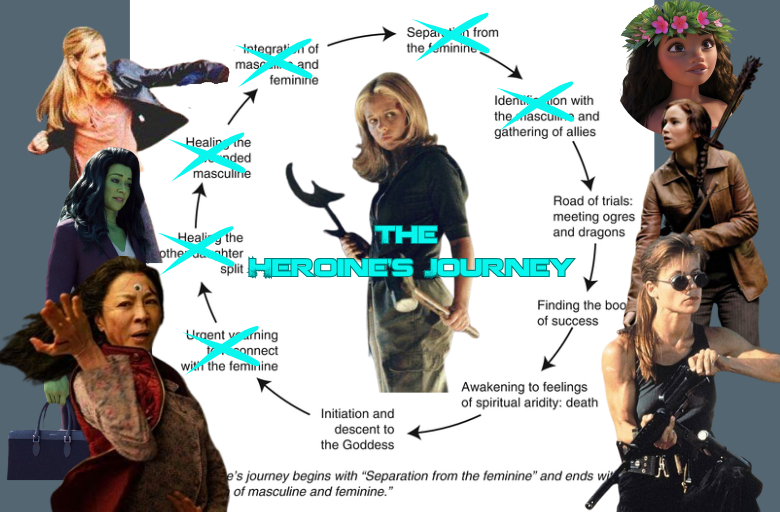
Batty mentioned that the audience needs to have a stake in the character’s development. We need to feel that a great deal will be lost if they don’t succeed, so I decided I needed to give my protagonist a more emotional transformation. I needed her inward journey to fluctuate more – “from despair to hope, strength to weakness […] and back again” As Vogler explains, a character without inner challenges seems flat and uninvolving, so I need to create an internal problem that will make the audience care more about the external problem. The Hero’s journey could have been more clean with a fantasy film, but the ‘Teachers are Heroes too’ concept is one I’d like to explore.
It becomes more complicated when writing a Satire as often the point is that they are anti-heroes, or that they don’t learn anything or grow. For instance, in the Blockbuster film ‘The Day After Tomorrow, the father’s journey is rather flatlined, as he doesn’t learn anything or develop throughout the film. While this doesn’t work in a Hollywood adventure film, it does work in South Park’s take on the film ‘Two Days Before the Day After Tomorrow’. The reason it works in satire is because we find it funny that the characters learn nothing and just push ahead anyway. Also due to the structure of a 20min animation comedy, the characters are reset (mostly) at the beginning of each episode anyway, so we don’t expect them to evolve or learn anything throughout.